Superhuman AI Automation
What is it and how does it work?


Table of contents
Put simply Superhuman AI Automation is when an AI performs a task at human level or above.
This is critical because most businesses don’t want to adopt technology that is tangibly worse, they’ve optimised what they need to pay to get the job done well and doing it worse usually just isn’t an option. Automation projects that don’t meet near human level or above, don’t go anywhere.
This is a large part of why 85% of AI projects are considered failures but once this superhuman boundary is achieved typically 70% - 95% of a business function can be automated.
The Superhuman AI Automation approach allows us to take machine learning models that are not superhuman and use “Superhuman Calibration” to find the subset of tasks on which the model can perform at superhuman levels. Then wrap this with the tooling and processes for experienced domain experts to keep improving the AI over time and help it adapt to new data.
As you can imagine the ROI for automating 70% - 95% of tasks while keeping or improving task performance tends to be pretty spectacular.
The setup
Most ‘if x then y’ type processes in business, where the output of a process is a simple set of well defined operations have already been moved into SaaS applications as part of the Digital Transformation wave of Web 2.0. The long tail of simple processes that didn't quite provide the economic benefit for bespoke software are being hoovered up by Robotic Process Automation (RPA).
You probably work for a company that managed the Web 2.0 Digital Transformation wave pretty well or no doubt the company would not exist. The primary way that businesses now interact with customers and employees has gone digital. Through email, chat, Web forms, self-serve portals, workflow systems and documents, the modern business is increasingly systematised where the inputs for an interaction / task come in digitally, the employee does something and they send a response / output somewhere else digitally.
This has set the stage perfectly for the large-scale automation of ‘Head Work’. Cognitive Automation has been experiencing huge growth and the below graphic gives a good idea of how to think about the difference between tasks that are cognitive and those that are covered by RPA or the move to Web 2.0.
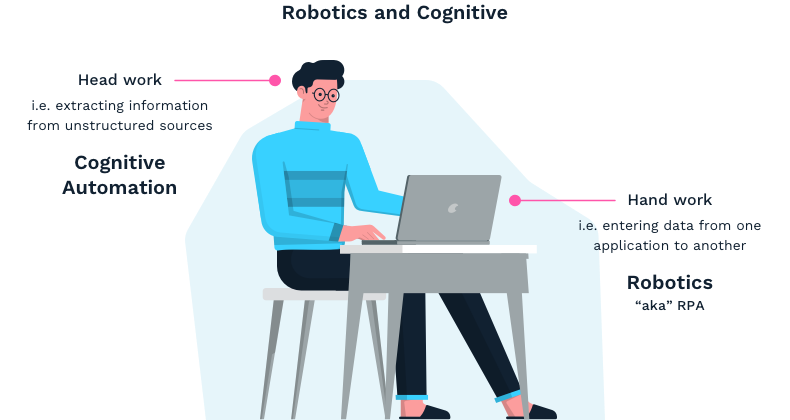
The main challenge is that the majority of head work tasks cannot be 100% automated to a sufficient level of performance by current AI for Cognitive Automation to be viable for the majority of tasks. The other factor is that Cognitive Automation is generally using pre-trained AI for a specific task.
That said, large portions of most repetitive head work tasks can be at least largely automated. This is where Superhuman AI Automation comes in, it’s not just about simple tasks or highly specific tasks. The tasks can be learned from scratch, tailored to your business and can require complex reasoning about a lot of data and interpreting unstructured data. Some examples include underwriting loans and interpreting the applicable law for documents but it can also be simpler head work tasks like reading emails and taking appropriate action or figuring out which customers are likely to churn and reaching out. Superhuman AI Automation is a framework for rapidly and safely automating the majority of the work in complex tasks, with human level or above performance. It is the cherry on the automation cake that allows for the automation of the most complex / costly work.
What is it?
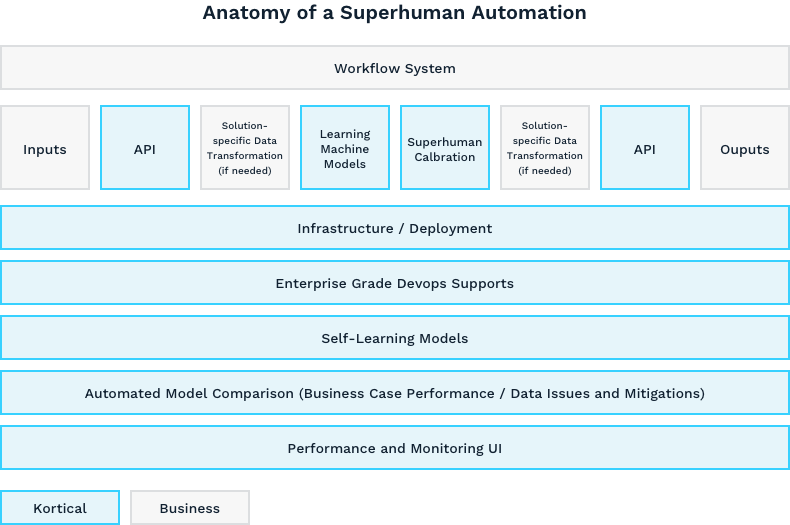
Superhuman AI Automation has 6 key components:
Using machine learning to analyse the inputs, often some combination of but not limited to tabular, form, statistical and document data. Then from this data generate the decision, insight, forecast, interpretation or other task and create the output that would usually be performed by a human. The quality and accuracy of the model is a key driver of the level of automation that will be achieved.
A key driver of model performance for a given task is how fast can the domain experts and data scientists can try out different experiments to try and improve the model. The crux of a fast iterative approach is interactive machine learning automation, so the user is very much in control of the solution being created but is vastly accelerated in creating it.
The Kortical platform has top performing AI to automatically create high performing machine learning models that outperform Google. A key difference though is that Kortical’s AutoML is interactive, so users can adapt, modify and constrain how the AutoML works easily. Through Kortical’s insights and your domain expertise you can further refine and improve the performance of the solution.
Even the best machine learning using the state of the art algorithms on high quality data, often underperforms humans. Given the nature of the complex tasks we want to automate using AI, there is often some level of human error that we can quantify and typically businesses need to at least maintain the current level of quality for customer experience or regulatory reasons and so failing to achieve at least human parity performance means that the AI project can't go anywhere and becomes one of the 85% of AI projects that result in failure.
As an example we might think that when replying to emails a person should be able to interpret the request correctly 100% of the time but in practice mistakes happen. We might find that the human error rate is 1 in 50 but that the best machine learning model has an error rate of 1 in 10 which is too high to let it serve customers. To mitigate this we use Superhuman Calibration to find the subset of the data on which the machine learning model has enough confidence to operate at superhuman levels. Then we only automate these tasks and as such maintain the requisite performance levels.
With Kortical’s Superhuman Calibration you can select a target accuracy and it will determine the automation rate it can achieve and calibrate the model to automate a subset of the inputs, while hitting that target accuracy. It can report on a variety of potential target accuracies and the automation that would be achieved allowing you to select the one that suits your needs best.
For the automation to perform at superhuman levels, it needs to be able to pass on the edge case or unfamiliar data for which the machine learning is not confident to a human for processing. The outputs of this process are captured to be used as training data and thus further refine and improve machine learning performance.
Typically the humans in the loop would need to process between 5% - 30% when the solution goes live and this would reduce over time.
There are a number of patterns for how the interaction between human and machine works but typically the Superhuman AI Automation hooks into the workflow system via API and for those tasks where the automation is not confident then the worker picks up the task as usual or where the automation is confident, it’s processed automatically and they never see it.
Kortical provides a number of customisable API endpoints that workflow systems can plug into to get predictions and save off training data to enable this process
As the humans in the loop keep adding new training data, for the AI to adapt to new situations, the machine learning needs to be retrained on the new data. Once the models have been created and Superhuman Calibrated, they need to either pass a series of automated tests and then be published automatically or send model comparison reports for the new challenger model vs the incumbent champion and let the business choose whether to publish the new model or not.
Doing this manually is a large amount of ongoing effort and a waste of precious data science talent but with Kortical this is fully automated except for the decision process.
Data changes over time, this is commonly called Data Drift. So understanding how your Superhuman Automation is performing over time is critical to having confidence in the performance of the automation.
As well as the model comparisons to be able to see if a new model will perform better, there should be a live view of the model performance with breakdowns and alerting to ensure that there is good visibility of the performance levels of the systems and alerting if there are any unexpected changes in the metrics. This is also combined with automated summary reports to give a good high level view of performance over time.
Kortical provides dashboards for easy performance monitoring and review as well as alerting for exceptional events.
While this may seem a little incongruent with the other pillars of Superhuman AI Automation which are more about how it works. We think it’s only right to give serious thought to the impact on workers who will be affected. As well as this, having a well structured change management process can help streamline internal adoption, increase the speed at which you realise savings from automation and avoid any potential bad press / glassdoor reviews.
We appreciate that this is something that is going to be quite company specific but some things we have seen work well are:
- Up-skilling workers to become AI trainers: With Kortical’s approach to Superhuman AI Automation there are still humans in the loop to continue to train and continuously improve the AI. These people essentially become AI trainers. By teaching them how to provide better examples for AI we can improve the data quality, which improves the automation performance and perhaps incentivise them based on the savings. This will give them valuable new skills, a new job title, prepare them for an AI enabled world and get them excited about the opportunity.
- Up-skilling to more high value work: The jobs that lend themselves to rapid automation tend to have aspects that are highly repetitive. Often the tasks automated are not the only responsibility of the workers that do them and there is more high value work they can pick up and having workers that are already familiar with the company can reduce training time over entirely new recruits.
- Advance Warning: It’s human nature to be wary of change, giving people as much advance notice as possible of what’s coming, what the new way of working will look like, plans for retraining, etc. will give people a chance to prepare mentally for the change and make them more open to it. As well as giving them time to prepare if they would prefer to leave.
- Attrition: Jobs with highly repetitive work which are perfectly suited to automation tend to have high employee attrition, slowing down the replacement rates as you get ready for roll out, ahead of it actually going live, can mean that there are fewer jobs to cut and that given the workload, the workers are glad of the support of the automation. Rather than fearing the sudden drop in workload once it goes live and what that might mean for them. Another benefit of AI automation is that once the majority of the routine and mundane work is done automatically, the work left is more engaging and leads to increased employee happiness and better retention.
A key component of Superhuman Automation is that it is most effective when applied to your core business functions. Creating your own models from your data has two main advantages:
- The solution is exactly tailored to your business, your ways of working, your best practice and so adoption & integration is easy
- The expertise, process and knowhow captured in that data remains your IP and your competitive advantage
For these reasons it’s often best to use a platform like Kortical that lets you build your own IP from your data and does not share the data or derivative AI IP with any other party.
While data lakes can enable more powerful machine learning, leveraging data from across the business, there are often a lot of low hanging fruit using the data that is already captured in workflow systems, CRMs, emails, etc. that are common in most businesses.
With Kortical we’ve really focused on automating as much of the creation and operation of a Superhuman AI Automation so it can be rapidly rolled out. The fastest we’ve seen for a cold start is 2 weeks to live. Even in large enterprise it can be as little as 3 to 4 months for the first automation, with subsequent automations also taking as little as 2 weeks.
How it happens
The typical process for adopting Superhuman AI Automation is to partner with a Superhuman Automation specialist to look at the main cost centres in the business, breakdown the job workflows and create a chart of the potential use cases with scores for both complexity and value and then use this to create a roadmap and to identify that first starting point.
The next stage is to create the first model from historical data. By withholding a portion of the data, to simulate new unseen data, the expected accuracy and automation levels can be determined before significant time or monetary investment is needed.
Then comes implementation, this phase can be variable depending on the complexity of the system that is being integrated with but typically for a modern REST based system, integration is quite straightforward and quick.
To help bring it to life, what makes a good starting use case is usually one that is fast to implement and give great ROI quickly. These are usually a complex question where the output of the task is a single answer:
- Do they qualify for the mortgage or not?
- Does this equipment need to be repaired?
- Which team should pick up this task?
- What’s the best price to quote on product X for company Y?
- How much of this will we sell next week?
- Is the answer one of these 50 common responses or does it need something more bespoke?
- Which legal precedent applies in this case?
The best ROI comes from finding a complex question that costs quite a lot to answer but has just one or two outputs, a decision, a price, etc. Then you build up from there adding more outputs, more tasks until the entire process is mostly automated. We have use cases using Superhuman AI Automation to translate complex unstructured files into structured data, so it’s definitely not limited to just these cases described but these tend to make the best starting points to get great results quickly.
Why
As Elon Musk said “companies have to race to build AI to remain competitive. If your competitor is racing to build AI and you don't, they will crush you,” while he doesn’t get everything right, he’s been pretty spot on about technology trends recently.
PwC estimate that AI will add $15.7 trillion to the global economy by 2030, that’s less than 10 years.
This is contrasted by Gartner stats showing that 85% of AI projects result in failure and those that are successful take on average 4 years to go live, so it’s safe to say that self discovery of best practice to adopt AI is not a safe bet.
The Superhuman AI Automation framework offers a robust structure and tried and tested tooling to successfully adopt AI automation that automates 70% - 95% of a process with human or superhuman accuracy and delivers real business value rapidly and incrementally. This has been proved across multiple industries and the results are incredible. Careers have been made off delivering a fraction of the value that is readily accessible with Superhuman AI Automation and it doesn’t require large investment to prove out. If you’ve ever kicked yourself for not jumping on a technology trend, this is not one to ignore.
If you’re interested in adopting or learning more about Superhuman AI Automation, get in touch with us here.

Ready to automate real work?
Contact us to see a focused demo and explore the quickest path to production.
Thank you!
A Kortical team member will be in touch shortly